If you are responsible for keeping a facility running — a data center, a hospital, a manufacturing line, a telecom site — you already know the uncomfortable truth about backup power: the purchase price is the smallest part of the bill. Diesel generators are inexpensive to buy and expensive to own. This article lays out a total-cost-of-ownership (TCO) framework for comparing aluminum-air backup power against the diesel default, written for the operations and finance leaders who actually sign off on the decision.
This is an educational framework, not a quote. The right numbers for your site depend on your load profile, run hours, local energy and fuel prices, and compliance environment. Use this to structure the analysis, then plug in your own figures.
Why Sticker Price Is the Wrong Metric
Capital cost is easy to compare on a spreadsheet, which is exactly why it dominates backup-power decisions it shouldn't. The problem is that a generator's lifetime cost is driven by the lines that don't appear on the purchase order: fuel, maintenance, downtime risk, compliance, and insurance. A rigorous evaluation reframes the question from "what does it cost to buy?" to "what does it cost to own and operate for the next five to ten years?"
The Five Cost Buckets That Actually Matter
1. Fuel
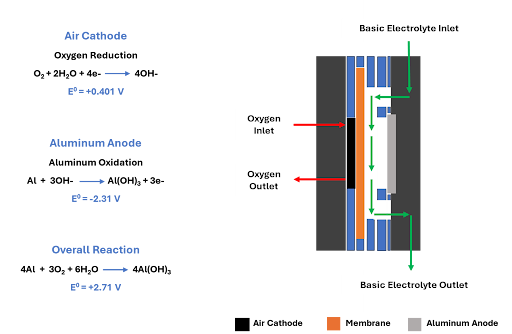
Diesel is a commodity, and commodities are volatile. Fuel prices swing with global markets, and for a generator that runs regularly, fuel is often the single largest lifetime cost. Aluminum-air changes the input entirely: the fuel is aluminum — the most abundant metal in the Earth's crust, at roughly 8% by mass — sourced through a mature recycling supply chain. A fuel basis built on recycled aluminum is structurally more stable than one tied to diesel spot prices, and it removes exposure to fuel-price surges during exactly the emergencies when you need the system most.
2. Maintenance
Combustion hardware is maintenance-hungry: oil, filters, coolant, exhaust after-treatment, and scheduled test runs all add up over a generator's life. An aluminum-air system has no combustion and far fewer moving parts, which structurally lowers the maintenance burden. Refueling is mechanical — swapping aluminum plates — rather than a fuel-delivery-and-storage operation.
3. Downtime Risk
For many facilities, this is the cost that dwarfs all others. An hour of downtime at a data center, hospital, or manufacturing line can run from tens of thousands to hundreds of thousands of dollars. The value of backup power is not the hardware; it is the downtime it prevents. When you quantify TCO, multiply your own hourly downtime cost by the reliability improvement — that number frequently overwhelms every other line in the comparison.
4. Safety, Siting, and Insurance
Flammable fuel is a liability in the literal, actuarial sense. Diesel and lithium-ion both carry fire risk that translates into siting restrictions, fire-suppression requirements, and insurance premiums. Aluminum-air uses a water-based, non-flammable electrolyte, which sidesteps that entire risk category. For hospitals, data centers, and occupied buildings, removing a fire-risk fuel source is both a safety win and a quantifiable cost avoidance.
5. Compliance and Emissions
Diesel generators bring air-quality permitting, emissions reporting, and growing exposure to carbon pricing. An aluminum-air system produces zero emissions during operation, which can simplify permitting and remove a category of future regulatory liability. As carbon costs move from voluntary to mandatory in more jurisdictions, a zero-emission backup asset shifts from "nice to have" to "risk hedge."
A Simple TCO Worksheet
When you build the comparison, add up the full picture for each option over a five-to-ten-year horizon:
- Upfront hardware and installation
- Lifetime fuel cost — and, critically, its volatility
- Maintenance, testing, and consumables
- Expected downtime cost (hourly cost × exposure)
- Safety, siting, fire-suppression, and insurance
- Compliance, permitting, and carbon exposure
- End-of-life value — where aluminum's recyclability and sellable byproduct create residual worth
Diesel tends to win line one and lose the rest. The exercise is not about a single magic number; it is about making the invisible lines visible, because those are the ones that dominate the total.
The Circular-Economy Line Item
There is one lever unique to this chemistry that has no diesel equivalent. The aluminum byproduct generated during operation — aluminum trihydroxide, or ATH — can be recovered and sold to secondary markets. In a well-designed program, a portion of the "waste" becomes a recovered-value stream, further improving the lifetime economics. Diesel exhaust, by contrast, is pure cost.
Does the Technology Actually Deliver the Power?
A TCO argument is academic if the system can't carry the load. Historically, aluminum-air's weak point was power output — it stored enormous energy but delivered it slowly. That limitation is closing fast. Peer-reviewed research in 2026 demonstrated a record peak power density of 710 mW/cm² for the chemistry, with strong sustained output in extended discharge testing. Higher power density means a given system footprint can serve more demanding loads, which directly improves the value you capture per dollar of installed hardware.
The best backup power isn't the cheapest box on the loading dock. It's the lowest total cost over its life — measured in fuel stability, avoided downtime, reduced risk, and recoverable materials.
How to Run the Evaluation
If you are a systematic evaluator — and the best operations and finance leaders are — the path is straightforward. Establish your baseline (current fuel, maintenance, and downtime costs), model the five-to-ten-year TCO for each option honestly, and pressure-test the assumptions. Where a claim depends on your specific site, ask for the source and the sensitivity. That is exactly the conversation we want to have.
Want to pressure-test these numbers against your actual load profile and site? Contact our team to walk through a site-specific TCO analysis.